 An Old Taoist Parable
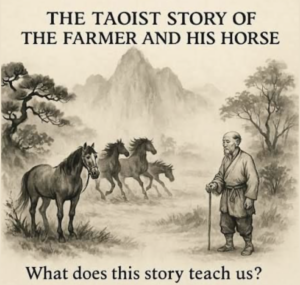
There is an old Taoist parable, sometimes called “Sai Weng Loses His Horse” or simply “The Farmer and His Horse,” that beautifully illustrates how fortune and misfortune are intertwined, and how quickly we label events as purely “good” or “bad.” It is a story about impermanence.
A farmer lived with his son and a fine horse that helped sustain the family. One day the horse ran away. The neighbors came to offer sympathy:
“Such terrible luck — your only horse is gone!” The farmer replied calmly,“Maybe. Maybe not. We’ll see.”
“Such terrible luck — your only horse is gone!” The farmer replied calmly,“Maybe. Maybe not. We’ll see.”
The next day the horse returned, leading six wild horses behind it. Now the neighbors rejoiced:
“What incredible fortune! You now have seven strong horses!” Again the farmer answered, “Maybe. Maybe not. We’ll see.”
“What incredible fortune! You now have seven strong horses!” Again the farmer answered, “Maybe. Maybe not. We’ll see.”
A few days later, while breaking in one of the new horses, the son fell and broke his leg. The villagers shook their heads:
“How unfortunate, your only son, injured!” The farmer said simply, “Maybe. Maybe not. We’ll see.
“How unfortunate, your only son, injured!” The farmer said simply, “Maybe. Maybe not. We’ll see.
”Weeks later, the emperor’s army swept through the region, conscripting every able-bodied young man for war. Because of his broken leg, the son was spared. Most of the other young men never returned. The neighbors marveled: “Your son’s injury saved his life, what a blessing!” The farmer smiled quietly and said, “Maybe. Maybe not. We’ll see.”
What does this Story Capture?
The story captures core Taoist wisdom: the principle of wu wei (effortless non-action) and the understanding that yin and yang, seeming opposites, constantly transform into each other. The farmer refuses to rush to judgment or to fight what arrives. He neither clings to apparent gain nor collapses under apparent loss.
Instead, he stays open, aligned with the Tao, the natural flow of life. His refrain, “Maybe. Maybe not. We’ll see,” is not passive resignation. It is active non-resistance: a refusal to prematurely narrow reality into a single story. By not forcing a conclusion, he preserves energy, clarity, and perspective.
We often do the opposite. Something painful happens and we declare, “This is awful. Why me?” Something wonderful arrives and we think, “Finally! Everything’s fixed.” Both reactions shrink the lens too soon. The parable gently asks us to widen it instead: What if this event is only one scene in a longer, unseen pattern? What larger story might this moment belong to?
Can we hold the question open long enough to let life show us? When we stop demanding that events be immediately “good” or “bad,” we stop exhausting ourselves in resistance.
We begin to move with change rather than against it and in that way we conserve inner strength, energy and we regain spaciousness.
And sometimes, not always, but often, we discover that what felt like disaster carried the seed of something essential, and what felt like triumph hid a hidden cost.
The deeper invitation is simple:
Can we trust life enough to say, at least sometimes,
“Maybe. Maybe not. We’ll see.”? That small shift in posture can change everything.
Can we trust life enough to say, at least sometimes,
“Maybe. Maybe not. We’ll see.”? That small shift in posture can change everything.
Leave a Reply