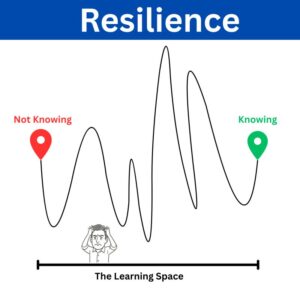
 What is the Learning Space?
What are its Neurological Benefits?
The Learning Space is the space between what you know and what you will master. It is the emotional and mental transition of moving from “not knowing” to “knowing.”
The Learning Space is hard & challenging. What emerges in that space is feelings of frustration, discomfort, uncertainty, fear of incompetence and embarrassment.
It was popularized by clinical psychologist Dr. Becky Kennedy. It’s an “in-between” phase learners experience when faced with a challenge.
Rather than rushing to fix the frustration or giving up, staying in this space helps build a growth mindset and resilience.
We all experience this transition when learning something new.
Take speaking a new language, learning how to play an instrument, adapting to a new routine, etc. Our brains tend to stick to the old and resist the new which requires effort, but the neurological benefits of developing this skill are multiple:
The primary neurological benefits of developing this skill include:
- Strengthening Synapses: Cells that fire together wire together. Confronting a challenge forces neurons to send electrical and chemical signals across new pathways.
- Thicker Myelin Insulation: As you repeatedly struggle and try again, the brain wraps these new pathways in a fatty sheath called myelin. Myelin acts like insulation on an electrical wire, allowing thoughts and skills to travel up to 100 times faster, making the once-difficult task feel automatic over time.
2. Emotional Regulation
3. Enhances The Growth Mindset Circuit
- When you reframe mistakes as part of the process, your brain activates the dorsal anterior cingulate cortex and the hippocampus.
- Instead of registering a mistake as a threat, your brain treats it as valuable feedback, sparking a healthy release of dopamine when you finally make progress.
- Deepens connectivity between memory, reward, and executive control centers
It is important to remember that when you are in that space you are evolving, what you really need is to PAUSE and become aware of the fact that that discomfort is a natural part of the growing process.
When you are in that space what you need is patience, self compassion, and the motivation to cross that space to achieve the confidence that you will manage what you see as hard and difficult right now.
You are in a transition space which is temporary until you shape your brain to accommodate the new skills.
Like David Ghiyam, the famous spiritual teacher explains, “Divine discomfort is the birthplace of your greatest expansion.”
Most of us have been conditioned to avoid discomfort at all costs. We seek ease, convenience, and paths of least resistance, never realizing that this avoidance blocks our spiritual evolution.
However, discomfort is not punishment, it’s preparation. Just as a muscle must be stressed to grow stronger, your soul requires challenges to expand its capacity.
What feels like a painful restriction is actually the Creator crafting your capacity for greater receiving. The areas where you feel most uncomfortable are precisely where your most profound transformations await.
Here ia a change of perspective for you: “I welcome divine discomfort as my path to growth. Every challenge is preparing me for my next level of manifestation.”
thank you for the inspiration! growth occurs stepping out of our comfort zones, so encouraging
Exactly. Every challenge we come across may contribute to our evolution.
The muscle analogy landed for me. Stressing the nervous system through tolerated frustration, the way we stress muscles to grow them, makes the neuroscience feel tangible. I also like the reframe of mistakes as feedback rather than threat. It explains why that healthy release of dopamine after pushing through feels so satisfying.
Thank you for your comment!! There is an area in the brain called the anterior mid cingulate cortex that is stimulated when we do challenging things. It is like a “tenacity muscle”. It acts as a structural center that integrates decision-making, motivation, and energy regulation to help you persist through difficulty. Neurological studies show that elite athletes, successful dieters, and “superagers” (older adults who maintain the cognitive capabilities of people decades younger) tend to have much larger and better-preserved aMCC structures. Ultimately, building discipline isn’t just a psychological mindset; it is a physical rewiring of the anterior mid-cingulate cortex every time you choose effort over ease. Going through the Learning Space gives us the opportunity to stimulate the aMCC.
Describing the learning space as the gap between not knowing and knowing is a helpful way to frame frustration. Being comfortable there makes learning easier. Thoughtful post.
Yes, self awareness in this respect takes anxiety and frustration away from the discomfort we may feel and can speed up our learning. Thank you for your comment!!