 Gratitude is an “attitude of reverence for what is good in life or goodness in the world,” Emiliana Simon-Thomas, science director of the Greater Good Science Center at the University of California–Berkeley, told The Epoch Times.
Gratitude is becoming aware that even when life is difficult, there are still things worth appreciating. It is a moral emotion.
Neuroscience has shown that being genuinely grateful primes the brain in tangible ways.
There are two regions in your brain that often compete:
- the amygdala, which perceives threat and drives aggression, and the
- the prefrontal cortex, which helps you stay rational and override reactive emotional responses.
Being able to see the good in life helps us to maintain a broader perspective, especially during periods of hardship
DR. Tatiana Denning said she often sees gratitude in her patients who are doing well : “They weren’t necessarily free of problems, but they had a way of appreciating life as it came, rather than allowing whatever had gone wrong to overshadow everything else.”
Gratitude is a skill you can train your brain to have.
The more these neurons fire, the more likely your brain is to feel genuinely grateful.
The practice of gratitude also triggers the release of dopamine and serotonin, making you feel the same joy you get from winning a video game or eating a sweet treat. The sense of reward from gratitude trains your brain pathways to notice more of the good. Over time, gratitude rewires the brain.
“The brain processes information in patterns. What comes into mind more often is what neural pathways come to anticipate,” Simon-Thomas said. This means the more you notice the good, the more good you will see.
In a study published in the Journal of Personality and Social Psychology, participants were randomly assigned to list either things they felt grateful for, hassles, or neutral life events. Those asked to list things they felt grateful for felt more hopeful about the upcoming week.
The Many Layers of Gratitude
On the surface, we can understand gratitude as being thankful for someone helping us, but at a deeper level, gratitude is resilience, creativity, and a way of living.
Just as money is a financial resource and food is a nutritional resource, positive emotions and virtues are resources for our mental energy. You can keep cultivating gratitude and let its positive energy accumulate.
Cultivating gratitude allows you to be less defined by your circumstances. It doesn’t encourage escaping or suppressing negative emotions. Instead, it helps you see difficult moments as opportunities to learn and grow.
Mindfulness practice teaches that the way you perceive and respond to a situation, will determine the emotional state with which you will experience it.
The circumstances matter, of course, but how you think about a situation can influence whether you feel completely overwhelmed or can approach it step by step.
A person’s ability to shift between acknowledging life’s hardships and appreciating the good is central to cognitive flexibility, a key tool that builds creativity,“
“This helps people cope with the inevitable ups and downs of life. Not ignoring the storm—but notice that you do have shelter or someone to ride out the rain with you,” Laura Kauffman, a California-based psychologist, told The Epoch Times.
When a loved one has passed away, Denning reminds herself how fortunate she was to have the years she did with that person and how different her life would have been had their paths never crossed.
“It’s sort of like in the movie ‘It’s a Wonderful Life,’” Denning said. While she still grieves the loss, appreciating the time they shared helps her recognize her blessings and the impact her loved one had on her.
Gratitude makes you humble. It makes you aware of your strengths and weaknesses, and respectful of others. This shifts your focus to appreciating being alive, belonging to something greater than yourself.
Tangible Benefits
Gratitude attracts gratitude, fostering “readiness to experience positive emotions,” Simon-Thomas said.
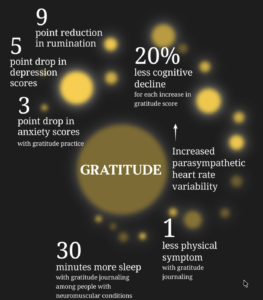
Higher gratitude levels have been associated with better cognitive function in older adults.
Beyond the mind, gratitude also benefits the body by activating the parasympathetic system, helping the heart recover more quickly from stress.
Ways to Practice Gratitude
Gratitude’s deeper power is a perspective shift, Kauffman said.
- She suggests first checking how open you are to “letting in” the good. People often get stuck on solving the problem and summarizing lessons learned, hoping to protect themselves from getting hurt next time. But being overly self-protective also keeps you from connecting with the “warm and beautiful moments.”
- You can connect with gratitude through nature and meaningful interactions. Simply noticing the light filtering through the leaves, between the leaves, the gradation of green in the different leaves, is so beautiful. You can experience this intense swell of awe and appreciation for nature. A moment of gratitude can take you out of your funk.
- Expressing in detail to a person what that person did for you which led to goodness and acknowledging the effort that they extended to do whatever they did is another beautiful way to connect with gratitude.
- In one study, researchers examined gratitude conversations between couples. They found that expressions praising the other person’s actions or qualities were associated with recipients feeling more understood, cared for, and more loving toward their partner.
- Writing a gratitude letter offers another proven way to improve mental health. In a study of adults seeking psychotherapy, participants were divided into three groups: counseling alone, counseling plus writing about stressful experiences, or counseling plus writing gratitude letters. Those who wrote gratitude letters reported better mental health weeks after the writing exercise ended.
- Listening to a gratitude meditation can help you access gratitude feelings in a deep way.
For those still struggling to feel grateful
“For those still struggling to feel grateful, it’s OK to lick your wounds”, Denning said.
“My intention is never to push someone into a place they’re not comfortable with or make them feel they’re coping the wrong way.
Rather, I want to help them find a little inner peace and develop some coping mechanisms that can help them navigate difficult times,” she said. “There’s no single right way to do that; we each have to find what works best for us.”
People can do something really small; find one thing you’re grateful for. “Even with everything I’m going through, is there something in my life that’s still good?”
It might be a small kindness someone showed, a helping hand in challenging times, or a flower blooming in the yard.
Sometimes, we can’t immediately change what’s happening around us, but we can gently widen our perspective to make room for something alongside what’s difficult.
The more consistently you practice gratitude, the more goodness your mind will focus on. Remember that you have the power to change the architecture of your brain every minute of the day by choosing to hold empowering thoughts. You have the power to choose.
Leave a Reply