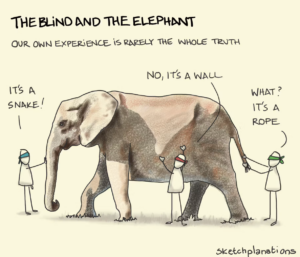
A long time ago in a village in India, there lived six blind men who had never seen an elephant. One day, word spread that a magnificent elephant had arrived in the village. Curious to understand what this creature was like, the six blind men went to examine it. Each man touched a different part of the elephant:
- The first man approached the elephant’s side and felt its broad, flat surface. “Ah!” he exclaimed, “An elephant is like a wall, solid and immovable!”
- The second man touched the tusk and felt its smooth, pointed shape. “No,” he said, “an elephant is like a spear, sharp and dangerous!”
- The third man grabbed the trunk, which was swinging gently. “You’re both wrong,” he declared. “An elephant is like a snake, long, flexible, and powerful!”
- The fourth man wrapped his arms around one of the legs. “Clearly,” he said, “an elephant is like a tree, thick, sturdy, and rooted to the ground.”
- The fifth man reached out and felt the ear, flapping gently in the breeze. “An elephant is like a fan,” he announced, “broad and flat, perfect for cooling oneself.”
- The sixth man seized the tail and laughed. “You are all mistaken! An elephant is like a rope, thin and flexible.”
The six men began to argue loudly, each insisting that his own description was the only correct one. Their voices grew louder and angrier until a wise man passing by stopped to listen.
He smiled and said:
The Meaning
This ancient parable (found in Buddhist, Hindu, and Jain traditions, and later popularized in the West by John Godfrey Saxe’s 19th-century poem) illustrates several important ideas:
- Partial truth: People often perceive only a small piece of reality and mistake it for the whole.
- Perspective matters: Different viewpoints can all be valid but incomplete.
- Humility and dialogue: True understanding comes from listening to others and combining knowledge rather than arguing over limited experiences.
- The limits of perception: What we “see” depends on where we stand (or, in this case, what we can touch).
The story is often used to teach tolerance, the value of multiple viewpoints, and the danger of dogmatic certainty. It’s a favorite in philosophy, religion, science, and even business discussions about complex problems
The wise observer represents the antidote: humility and openness to multiple viewpoints. This parable illustrates how confirmation bias fragments reality and fuels unnecessary conflict.
Key Teachings We Can Apply in Daily Life:
Here are the most practical lessons from the parable:
- Embrace Humility About Your Own Knowledge
Your perspective is real and valid—but almost always incomplete. What feels like an absolute truth to you (based on your experiences, role, or limited data) may be just one facet of a larger reality. In life, this means pausing before declaring “This is how it is” in arguments, decisions, or opinions. Ask yourself: “What part of the ‘elephant’ am I touching?” - Seek Out and Value Diverse Perspectives
The blind men could have understood the elephant better by listening to each other and combining their observations. In your own life, actively invite input from people with different backgrounds, expertise, or viewpoints—colleagues, family members, or even critics. This is especially useful in teamwork, problem-solving, relationships, and leadership. Collaboration often reveals the “whole” that no one person can see alone. - Avoid Dogmatism and Reduce Conflict
Much unnecessary arguing, polarization, and misunderstanding comes from assuming others are wrong (or lying) simply because their experience differs. The parable encourages curiosity over combativeness: “Tell me more about what you’re experiencing” instead of “You’re mistaken.” This applies to politics, religion, workplace disagreements, and even personal relationships. - Practice Empathy and Open-Mindedness
Each blind man was sincere and not entirely wrong—his description matched his limited sensory input. Recognizing this fosters empathy: others aren’t usually being malicious or stupid; they’re often describing a different part of the same reality. This mindset helps in negotiations, counseling, teaching, and everyday interactions. - Pursue a Bigger Picture
True wisdom involves integrating multiple viewpoints rather than clinging to one. In practice, this could mean researching broadly before big decisions, using data from various sources, or reflecting on how your “mental models” (as systems thinker Peter Senge called them) might be limiting you. It also reminds us that some truths (like complex systems, human behavior, or spiritual realities) are inherently hard for any single person to grasp fully. - Be Willing to Update Your Understanding
If the blind men had stayed curious and touched other parts (or asked others to guide their hands), they could have revised their views. In life, treat beliefs as provisional. Be open to new information that expands or corrects your initial impressions.
Everyday Applications
- At work: When a project stalls because departments see it differently, remember the elephant and map out all the “parts” together.
- In relationships: Instead of insisting your view of a conflict is the only one, explore your partner’s “part of the elephant.”
- In society: The parable cautions against echo chambers and extreme relativism alike. It promotes dialogue and synthesis rather than dismissing others or claiming no objective truth exists at all.
- Personal growth: Regularly expose yourself to new experiences to “touch” more of life’s elephant.
The story doesn’t mean all opinions are equally valid or that objective truth doesn’t exist. It means we should approach truth with humility, curiosity, and a commitment to seeing more broadly. By internalizing this, we argue less foolishly, understand more deeply, and make wiser decisions.
A beautiful story, imparting so many valuable lessons!