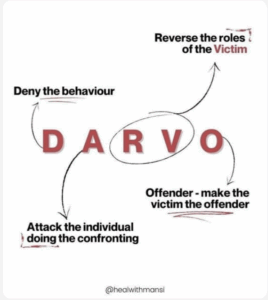
 The DARVO Tactic is one of the most disorienting manipulation tactics out there, and once you know what it is, you’ll start seeing it everywhere.
What does the term stand for?
- DENY
- ATTACK and
- REVERSE VICTIM and
- OFFENDER
It’s a way to shift blame away from the abuser and make you seem like the one at fault. Harsey, S. & Freyd, J.J. (2020).
EXAMPLES
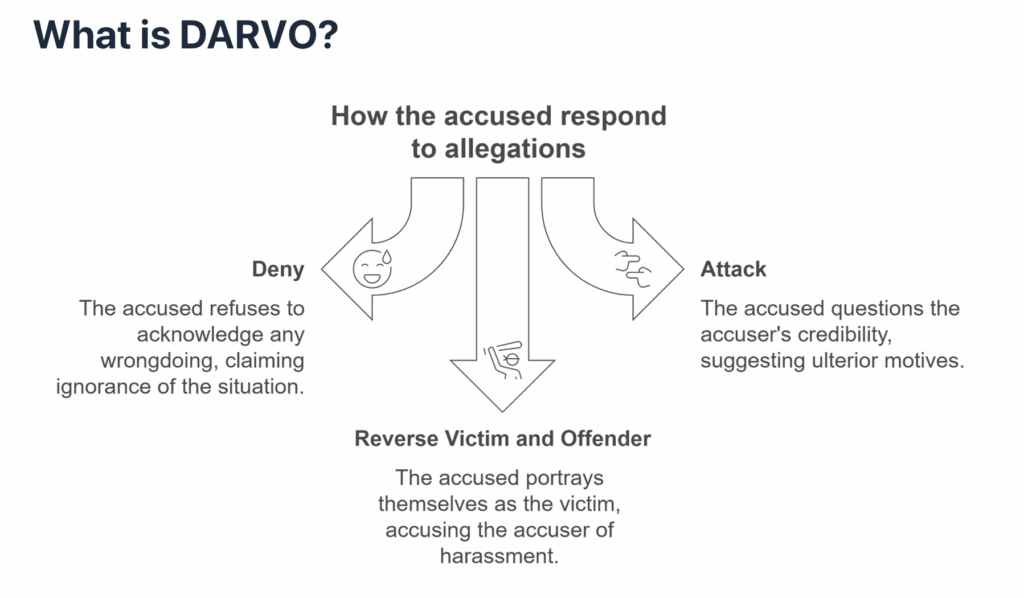
DARVO is a defensive mechanism that serves to discredit victims and deflect accountability. It consists of three sequential components:
DENY: The accused outright denies the allegations, refusing to acknowledge any wrongdoing.
Example: “I have no idea what you’re talking about; that never happened.”
ATTACK: Following the denial, the accused attacks the credibility, character, or motives of the accuser.
Example: “You’re making this up to ruin my reputation because you’re jealous.”
REVERSE VICTIM and OFFENDER
The final step involves flipping the narrative so that the accused presents themselves as the true victim, and the accuser as the offender.
Example: “You’re harassing me with these false accusations; I’m the one being wronged here.”
Psychological Mechanisms Behind DARVO
DARVO operates through several psychological processes:
- Projection: Attributing one’s own unacceptable thoughts or feelings to someone else.
- Gaslighting: Manipulating someone into doubting their own perceptions or sanity.
- Deflection: Shifting attention away from oneself to avoid blame.
These mechanisms serve to protect the self-image of the accused and maintain control over the situation.
It’s a psychological sleight of hand, a way for someone to flip the entire script the moment you try to hold them accountable.
DARVO is an extremely common tactic that almost all victim-survivors of both stalking and domestic violence, particularly coercive control, are familiar with.
How does it play out?
Here’s how it plays out: You bring up something that hurt you calmly, respectfully just trying to talk.
Step one they deny it that never happened, you’re making things up or you’re being way too dramatic then comes
Step 2 they attack you. They go after your tone, your timing, your past. Suddenly it’s not about what they did. It’s about how you brought it up. And then comes the flip: They make themselves the victim. You’re not the one who got hurt, they are. They’re being attacked. They can’t do anything right. They act like your honesty is cruelty, and now you’re the one who has to explain yourself.
That’s DARVO. It’s not just emotional manipulation. It’s narrative control. It turns any conversation about harm into a performance where the person being called out gets to play the hero, the martyr or the victim. And if you’re on the receiving end, it can make you feel confused, ashamed even guilty for speaking up.
You start wondering if you were too harsh, if maybe you did come off wrong. You start defending your tone instead of your truth.
Impact of DARVO on Victims
Victims subjected to DARVO may experience:
- Self-Doubt: Questioning their own memories and judgments.
- Emotional Distress: Feelings of guilt, shame, or confusion.
- Silencing: Reluctance to come forward or pursue justice due to fear of not being believed.
How do you deal with it?
First don’t take the bait. If the conversation suddenly becomes all about their pain, their suffering, their offense, pause return to your point, stick to the facts. Say I’m willing to talk about this but not if the original issue keeps getting buried.
If there is not change, the interaction will go nowhere, and the energy will become toxic. Your only recourse is to remove yourself from that environment.
How to Respond to DARVO
- Stay Grounded in Your Truth. One of the main goals of DARVO is to make you doubt yourself. …
- Do Not Engage in the Blame Game. …
- Set Clear Boundaries. …
- Recognize When It’s Not Worth Engaging. …
- Seek Support from a Mentor or a Therapist.
Conclusion
DARVO is a manipulative response that undermines accountability and harms victims. By understanding its components and recognizing its manifestations, individuals can better protect themselves and support others who may be subjected to such tactics. Awareness and education are vital in combating DARVO and fostering environments where truth and justice prevail.
References
- Freyd, J. J. (1997). Violations of power, adaptive blindness, and betrayal trauma theory. Feminism & Psychology, 7(1), 22–32.
- Harsey, S., Zurbriggen, E. L., & Freyd, J. J. (2017). Perpetrator responses to victim confrontation: DARVO and victim self-blame. Journal of Aggression, Maltreatment & Trauma, 26(6), 644–663.
- Stamant, R. (2020). DARVO: Deny, Attack, and Reverse Victim and Offender. The Journal of Forensic Psychiatry & Psychology, 31(6), 827–845.
- Smith, C. P., & Freyd, J. J. (2014). The problem of failure to acknowledge mass rape in war. Journal of Trauma & Dissociation, 15(3), 201–212.
- The association for Integral Eye Movement Therapy Practitioner. Integraleyemovementtherapy.com
I always wondered about this. I have been a victim of this behavior since early childhood. I was made to look wrong by my mother, then my sisters. I was either ignored, punished or bullied, and some incidents, physically abused. I felt bad & wrong all the time for being a simply active & curious child who was different than them. I always prayed silently to God for forgiveness. This continued into my adult life. I removed myself from my family for periods of time. After both parents passed away, one sibling in particular tried to take over my life, under the guise of trying to ‘help’ me when I was ill. This became unbearable to the point of physically beating me into submission. I forgave her. Now, I regret not reporting it to the police for I had no witnesses. She has abused several others inside & outside her family and has gotten away with it. Eventually, after she continued this behavior towards me, I called her out & finally walked away. Of course I look like the wrong one because I refuse to engage with her any longer. I’ve received little support from my other siblings. After almost two years, she’s tried to come back to assert her control once again, stating that she will not tolerate any “violence” perpetrated on her when she is the only one that’s been physically violent.