What is Confirmation Bias?
How can we Mitigate it?
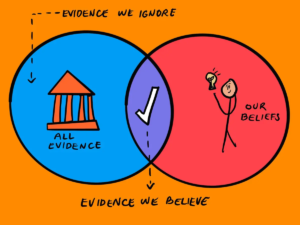 Confirmation bias is one of the most well-documented and pervasive cognitive biases.
It refers to the tendency to search for, interpret, favor, and recall information in a way that confirms or supports one’s prior beliefs, values, or hypotheses, while ignoring, undervaluing, or dismissing contradictory evidence.
Core definition and mechanisms confirmation bias operates on multiple levels:
- Selective search: Actively seeking evidence that supports what you already think.
- Biased interpretation: Twisting ambiguous information to fit your views.
- Selective memory: Better remembering confirming facts and forgetting disconfirming ones.
- Avoidance of disconfirmation: Actively steering clear of information that might challenge your beliefs.
It is largely unconscious and automatic, making it especially difficult to detect in ourselves.
Psychologist Peter Wason popularized the modern concept in the 1960s through experiments like the “2-4-6” rule-discovery task, where participants tested hypotheses by seeking confirming examples rather than disconfirming ones.
Roots trace back further: Francis Bacon described it in 1620, noting how the mind latches onto supporting evidence while disregarding contradictions.
Connection to The Blind Men and the Elephant. This bias directly mirrors the parable I discussed in one of my past posts. Each blind man clings to his limited sensory experience (wall, spear, snake, etc.) and argues against the others. They exhibit classic confirmation bias by:
- Interpreting new information only through their existing “piece.”
- Dismissing alternative perspectives instead of integrating them.
- Becoming more entrenched as the argument intensifies.
The wise observer represents the antidote: humility and openness to multiple viewpoints. The parable illustrates how confirmation bias fragments reality and fuels unnecessary conflict.
Everyday and High-Stakes Examples
- Personal life: You believe a certain diet is superior. You eagerly share success stories and studies supporting it, while downplaying or rationalizing away negative experiences or contrary research.
- Politics and social issues: People consume news from sources that align with their ideology and interpret the same event (e.g., a protest or economic report) in ways that reinforce their side, ignoring other perspectives.
- Business: A manager convinced a new strategy will work focuses on positive early indicators and ignores warning signs (as in the coffee shop location example).
- Science and investing: Researchers may unconsciously favor data supporting their hypothesis; investors hold losing stocks longer because they seek information confirming their original analysis.
- Relationships: Assuming a partner is selfish leads you to notice every self-serving act while overlooking generous ones.
In the digital age, algorithms amplify this bias through filter bubbles and personalized content.
While it may conserve mental energy and reinforce social bonds within groups, it also protects self-esteem and reduces cognitive dissonance (the discomfort of conflicting beliefs). However, in modern complex environments, it often leads to poor decisions and divisiveness, with dire consequences:
- Polarization in society and “echo chambers.”
- Scientific errors and stalled progress.
- Bad financial, medical, or career choices.
- Ignorance of relevant facts that may contradict our biases.
- Misinformation spread, as people accept confirming “facts” more readily.
Recent studies (2024–2025) show it interacts with strong political beliefs, low-effort thinking, and even AI interactions, where hyper-personalized responses can reinforce biases further.
How to Mitigate It
Awareness alone helps modestly, but active strategies work better:
- Become curious about other people’s point of view and see how they reached their opinions.
- Listen carefully without discrediting the person’s opinions before sharing your ideas
- Actively seek disconfirming evidence. Ask: “What could prove my belief wrong?” Deliberately search for opposing views.
- Consider the opposite. Force yourself to generate arguments against your position.
- Use structured decision-making. Devil’s advocate, pre-mortems (imagine why a decision failed), or red-team exercises.
- Diversify inputs. Follow credible sources from different perspectives; engage in good-faith conversations with people who disagree.
- Slow down. Pause before concluding, especially on emotionally charged topics.
- Track predictions. Keep a journal of beliefs and outcomes to review accuracy over time.
In groups, appoint a devil’s advocate or use anonymous feedback to reduce social pressures.
Confirmation bias is universal. No one is immune, including those who pride themselves on being “open-minded” (a meta-example of the bias).
The path to better thinking lies in the same humility taught by the elephant parable: recognizing that our perspective is always partial and that wisdom comes from integrating more pieces of the elephant.
Cultivating curiosity over certainty is one of the most powerful mental habits you can develop.
Excellent
Thank you for your generous comment, Sam. I am curious, what did you like about the blog?
Where to start? You have a knack for finding deep yet fundamental insights into human beings. Your reading and research (quotes) reveal how meticulous your grasp is. And you explain it clearly, point by point, in a way that is understandable and helpful.
There’s much more to be said about this subject. Reasoning is the number one function of the mind. If we don’t get that right… all the rest is off.
Confirmation bias is one hindrance that is highest on the list of false reasoning… and possibly the most difficult to overcome. When someone believes something… they generally are unshakeable. A person really has to be honest with themselves to look at real, true facts and face them. Today, “non-facts” are a common commodity, and once people latch on to them and are convinced… that’s confirmation bias, and they are stuck.
You know I could say more, but not here. You have so much talent and insight; keep putting it to use helping others as you always do
Thank you, Sam. This is a generous and thoughtful comment. You’ve named something essential: if reasoning is off, everything built on it wobbles. Confirmation bias is high on that list because it makes us feel righteous while we ignore what doesn’t fit. Being willing to look at real facts, especially when they unsettle us, is rare and necessary. I hope you’ll say more when you can. In the meantime, I’ll keep trying to write in a way that helps people notice their own blind spots with a little more kindness.
Without going into details, I’ve written tons on consciousness and mind, and the number one characteristic of humans is that they have been given “reasoning” for a purpose. So you’re right to focus on that, and blind spots are a key handicap. A wise man said, “That which I see not teach you me.”
Another characteristic of humans is their free-will choice. How we use facts and make decisions is one of our fundamental traits; that’s reasoning. You’ve written about that too. Your warmth already helps those around you grow and flourish.
Thank you Monica, this was a great read for me. I like how you pointed out how universal confirmation bias is and gave actionable next steps. This awareness can bring us all a little closer together. It is humbling to reflect on how much bias is within the human mind.
Thank you, John. I’m grateful you took the time to write this. Confirmation bias is especially stubborn because it feels like loyalty to what we already “know.” Honesty with ourselves is the hard part, very humbling like you say, but it is the beginning of better reasoning. And you are so right when you point out that awareness of the confirmation biases we hold can bring us all a little closer together.
Your breakdown of selective search makes it easy to spot confirmation bias in my own habits. I like that you go beyond the definition and look at how to actually mitigate it. Mindfulness seems like a natural tool for noticing when we’re only looking for agreement.
Right! Self-awareness is an amazing tool that allows us to be in contact with our own confirmation bias, even when we find it uncomfortable.